The Shower

arms crossed, shower water. groaning, grunting

grimace, snort and turn to face the stream.

the glass-block-window’d winter setting sun and steam.

a finger trailed along its ridge, resting head against the tile

sliding hands against your skin to see how you are made again

you are yourself and no one else can know

this life is passing fast and when you think you have it down

you don’t. you turn and look around and everything has blurred

receded, burned, obscured, returned. and not a single word

remains. the memories of a day, the rain, the sun, the urge to run.

a decade here, a decade there. you think ‘rehearse! rehearse!’, I must prepare.

with careful steps avoiding pits and traps, injuries and error

conflict, audits, accidents. 

a perfect go, a trial run with no mistakes. a ten of ten for when 

they open up the stage. and then, as water trickles off your knee

shivering in the shower from fifteen to forty-three,

it seems, you may have had enough. it’s time to go

to stop. to leave and start the show. to twist, and turn

the water off, the drops and drips, the skips and fits.

your naked childhood body now in pants, the force of gravity for half

a life, pulling on your cheeks, your balls, your hips, your hands.

and at your age you don’t know how to stand, have things

gone well, or ill, or good, or bad?

what consequences can you claim?

is it not now past time for something new?

for something wonderful and true? 

and real, without a trace of guilt or shame.

facing brave what might be left,

without a label, or a name.

reborn! another step out from the shower! 

and after just three quarters of an hour.

one admits to feeling old.

and anyway the water’s cold.

East

“But, why me?”, asks Bixby.

“Because, Mr. Hermann, we need a man to do an impossible job.”

“Impossible?”

“Yes. We need a man with NO pretensions. Do you understand me?”

“No pretensions?”

“None.”

“But sir,” Bixby quivers. “I don’t think I can do it. I don’t think anyone can – ”

“Hermann stop it. Stop. Listen to me. Look at me. Are you looking at me?”

“Yes sir.”

“We need a man like you. You’re the man we need. And anyway there’s no time for discussion, see. These cards must be shuffled. The top men here have studied it. Meetings. Experiments. Do you know about the experiments?”

“No sir.”

“Well. Believe me. We don’t do things willy nilly around here.”

“But Mr. Anderson, sir. Uh, General Anderson – I’m not even in the, uh… service. You know? I’m just a dentist.”

“Exactly! Now you’ve got it. Just the man we need – and no pretensions. Ahh, Bixby!” General Anderson smiles broadly, “I admit, I had my doubts, but now I see HRC was right. Couldn’t be righter!”

“Oh.”

“Now then. Take these,” Anderson says, handing Bixby a set of playing cards. “I want you to shuffle them, see? And then starting walking thataway.” General Anderson lifts his right arm and points, squinting.

“When you can’t go any further, well, you just turn around.” Anderson mumbles, looking off in a different direction. Then he snaps back toward Bixby, leveling his gaze. “And always shuffling! Shuffling that deck!”

The sky is a flat, washed gray screen. The road rolls gently and rises, a faint line of wire fencing beside it.

Bixby looks down at his hands. Then he lifts his head and looks east, into the distance.

Stumbling

Easter when
he rose
he couldn’t see
his toes
you know the way
that goes?

Again
he rose
to feel
the ground,
spongy wet
and sucking
at his feet,
slurping sloshing,
sweet.

A marsh.
A cross.
The cattails bent
from heavy snows,
and moss,
and mud.
He rose because
he could.

To cross
a marsh
as if he could
by miracle.
Walking
on the ground,
soaking cold
and marshalling
his breath.
Snapping sinking
death.

He rose
because he rose.
You know the way
that goes.

Et tu, Fernie?

It’s twenty minutes to close when the doorbell chimes and two middle-school-aged boys enter the shop. Newt, the chinchilla, is frenzied, running on his wheel as fast as he possibly can.

Mack looks up from the cutting board, where he’s chopping bananas and lettuce for the day’s last feeding. He’ll close up soon, feed the animals, and then ride home. He scratches his thick, gray, yellow-stained mustache, revealing forearms marked with tattoos that say “Goodness Snakes” and “Boa-lieve it”.

In the fish aisle a little girl in a pink skirt is sitting on a man’s shoulders and tapping on the beta’s bowls.

Continue reading “Et tu, Fernie?”

Simmer

What is a storm? Xylem or phloem?

When lighting moves closer and we turn to go and

the lake says, no, don’t leave me I’m always

abandoned, I always remain on my own,

remanded, planted where nothing can grow.

The night is short and the clouds are low,

and where could I shelter? Nothing is right.

The water is crossed and recrossed with each thundering strike,

of a poem, of rifts in the fabric of time,

of words that unite, and recoil,

and sink to the bottom to sit in the soil,

and boil.

On my night off

My pecs are sore.
They’re sore!
I drank one beer or maybe
more, and prior to that,
before, I performed push-ups
on the floor
until I could push up no more
and earned that one
or two or three or five
or was it four?
Those beers they poured.
That now my ears have caused to ring
my head to swim my breath to lung.
Oh, I admit
it was just one.

This is gonna be awesome

It was a mild, gray, damp day, and I was home alone, doldrumic, with my three-year-old son, Zev. So I invited my dad over to hang out with us. Three generations, no plans or prospects to do anything.

I thought we could go to the zoo, or kick around a soccer ball, or go to the library, but no one (including me) seemed interested.

Instead we got in my dad’s car, and I suggested we head to the river for a hike. En route, Zev vetoed my plan with crying, and his grandpa, appeasing him, promised an adventure to ‘The Greatest Tower in the World!’.

I huffed and groaned but kept quiet. This is quintessentially my dad. Once you’re in the car, going someplace, he spontaneously suggests going somewhere else. On road trips he stops randomly at small-town post offices, or predictably, at every single historical marker. He drives slow.

I was annoyed. I had other things I wanted to be doing (even if I didn’t want to admit it). And now we were crawling along at 10 miles per hour toward the neighborhood water tower.

Bah! Why are dads so exasperating!? 

We got out of the car at the Greatest Tower in the World, and I struggled to contain my irritation. This is not an activity! Going to a water tower. This is not a thing people do, it’s just … nothing!

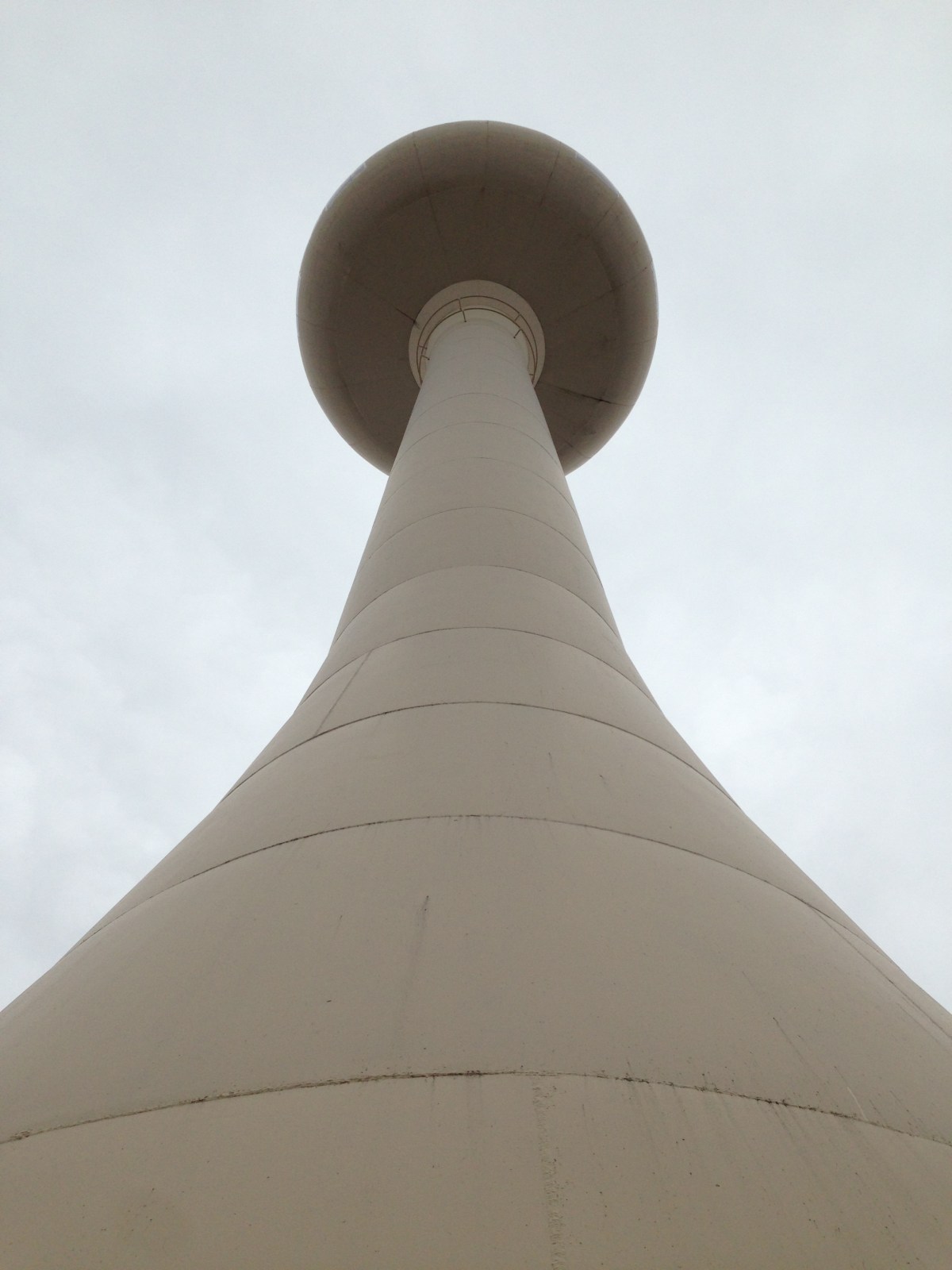
And then, quickly, everything changed. I looked over and saw Zev standing at the base of the tower with his body pressed against the cold, painted steel, looking up at the huge ball looming above us in the clouds. He was in awe.

This is a something I pass by – and utterly ignore – a thousand times a year. It is, objectively, just a boring water tower.

But in a three-year-old’s eyes (and with his grandfather’s help), it became the greatest tower in the world.

“This … is so … AMAZING!” said Zev. (If you can’t hear him, inside your head, saying this in his signature, particular way, then ask me to do an impression next time you see me.)

We put our ears to the metal and banged our palms against it, listening to the sounds rumbling and reverberating in helixes within the giant structure. We ran around it in circles, chasing and evading each other. Reversing directions and laughing. No one was around.

When you allow a little adventure to begin, it’s amazing how it continues. Soon Zev found a fire escape to climb up and hang from. Then there was a wall of granite landscaping boulders to scamper down. Taconite pellets. A little wood with downed trees to balance on, and a dead squirrel to poke.

Soon we were just walking around, exploring, pointing things out. “Close your eyes, guys,” Zev instructed us. “I have something really AMAZING to show you!” We did. He showed us.

It was a trash compactor with a ventilation fan spinning madly, thirsty for lubricant. He was right. It was amazing.

We stopped by the barns at the university farm campus near our house. Clutches of newborn lambs huddled together, skittish and furry-legged, yanking at their mother’s udders. Zev held out a clump of dry hay for them, saying “Come ‘eeeere little lambies, come here!”.

They didn’t come. The mother approached and pinned her ears forward, hooves stamping.

We found the cow barn; it was full of new calves and expectant mothers. They were friendlier, more docile. To Zev’s delight, the calves sampled his offerings of grass and corn. But they were soon more interested in licking his clothes and slobbering on his hands. He scrunched his face and half-turned away, squealing, but stood fast.

In the end we spent about an hour doing, essentially, nothing. We started with no plan, and allowed the adventure to seep into our afternoon, unencumbered.

When I think about it, I realize this is exactly the kind of thing I most love doing with my kids. I must admit that, I too, on road trips, have a certain penchant for stopping randomly, taking photos by road signs, and even making visits to post offices.

Many an afternoon I have spent wandering around with one (or both) of my kids, directionless and drifting, until some tiny detail catches our attention and changes the course of the whole day.

Am I exasperating? Do I annoy them? Will they someday groan and sigh and glare at my foot, resting, light as a snowflake, on the gas pedal?

Not yet, but someday, maybe. For the moment, I’m going to stick to the plan, and try to get in as many aimless afternoons with them as I can.

And I’m going remember I didn’t invent this idea. It was taught to me, lovingly, sometimes exasperatingly, by my dad, on cloudy Sunday afternoons many years ago, when a water tower, a trash compactor and a cow’s slobber were all it took to make me smile and say, “Amazing.”
Ice Breaker

He looks west to where the clearing should be but the horizon is gone, swallowed by snow. The ship’s iron hull, forty-eight millimeters thick, groans against the fresh ice. He cups his hands together and blows into them, then straightens his sunglasses.

The south-west passage should be open – it’s usually open – even this early in the season. And the Halvljus has opened this very route dozens of times before. Palms sliding down his gray-blonde beard, he recalls the first time he made the trip, as second navigator, seventeen years before. It was the peak of the oil crisis, and the ship’s radio was tuned to the state broadcasting service every morning for scratchy snippets of the latest news.

Now Ryuikssen comes with news of the Finnish breaker, Kontio, sent to pull them out. She’s delayed south of Negerpynten; running too light, it seems.

“And what about Andres?” he asks.

“Fine,” Ryuikssen says. “In quarters, recovering.”

“And the girl.”

Ryuikssen looks down. His blonde hair is thinning at the top and his lips are chapped to white.

“I don’t know,” he says. “She’s talking but no one understands.”

The captain of the Halvljus turns his head, cracks his neck to the right, then the left, heaves his chest and sighs. Three weeks ago he left Maarit and the baby in Luleå. It had been early morning when they went out, and from the pier he could see the cathedral spire covered in frost; the city beginning to light up behind it. The baby was wrapped up so tightly only her face showed, and Maarit, her hair pulled back, looked upset.

He didn’t know what was wrong. He thought to ask her in the car on the way over, but couldn’t bring himself to do it. Instead he stared out the window, watched the refinery lights go by. When they reached security he gave her his badge to show the guard. In the side mirror he saw the baby’s pinched face and then reached behind awkwardly to hold her mitted hand.

“I’m pregnant,” Maarit said now, looking away, and then directly into his eyes. “I’m pregnant again.”


Leap-Day Morning

The neighbors asleep with the leaves in their trees standing quietly insensate to cold. The wind’s hips sway and she brushes the bushes and last fall’s remaining grasses.

Creak, down the stairs, walking backwards, toe to heel. Singing that chorus for half an hour, lying in bed without success. A tornado of images and words and sounds screeching and scraping against each other. They crack and shatter and reassemble and fly by unrecognizable.

A day is starting. A night is ending. Neither really started or stopped. Last night I went to bed and felt I had completed one more thirty-thousandth of my life, and that somehow I should be taking better stock of these fractions. The present is distant, and yesterday wanders my memory seeking an open chair.

The middle-school buses growl from one stop sign to the next, and I cover my face with a pillow. The sun goes up across the street. A yellow house bathes in the light, the rest is gray and brown and pale blue.

I would have skipped this day, last year. I’ll not miss it the next. I yearn to see the sky through languid curtains deep green and songbird-filled.

I should value every day. I should be present and grateful. But this Februaric extension I will not applaud.

I never liked the month in the first place.